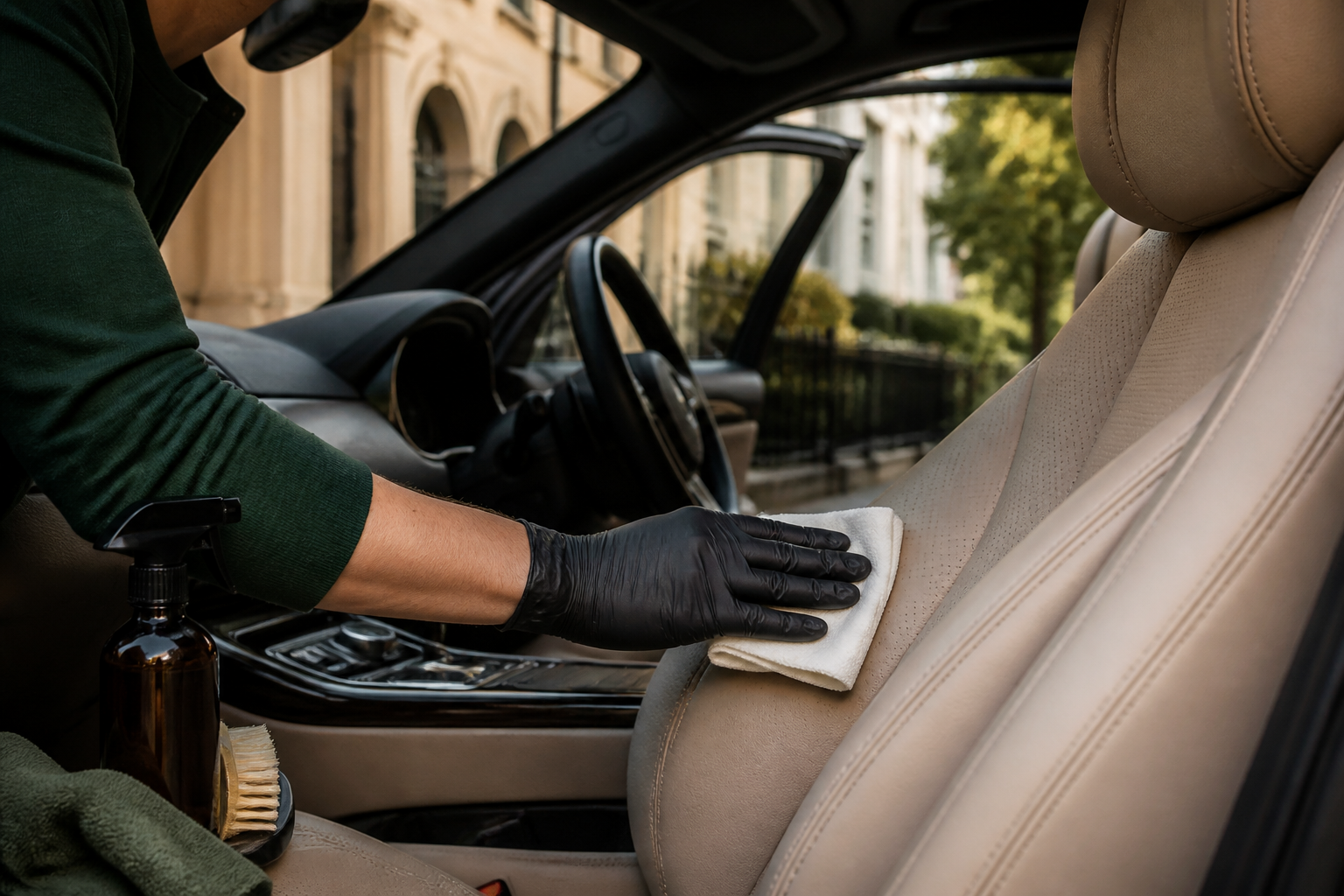
To clean leather car seats without cracking them, use a pH-neutral leather cleaner (never household detergents or bleach), work in small sections with a microfibre cloth, remove dirt gently without scrubbing aggressively, then immediately follow with a dedicated leather conditioner containing natural oils or lanolin.
The conditioner step is non-negotiable—it replaces the oils you've stripped during cleaning and maintains the leather's flexibility.
In London's climate, condition your seats every 8–12 weeks minimum, more frequently if you park on-street where UV exposure through windows, seasonal temperature swings, and moisture from damp air accelerate drying.
Never use baby wipes, kitchen spray, or tap water alone—London's hard water leaves limescale deposits that abrade the leather surface over time. This two-step clean-then-condition routine keeps leather supple, prevents surface cracking, and preserves the factory finish for years.
Why leather car seats crack (and how London accelerates it)
Leather is animal hide treated with oils and dyes. When those oils evaporate or get stripped away, the hide becomes brittle and develops surface cracks—exactly like dried-out skin.
-
UV exposure: Even on overcast days, UV rays penetrate car windows. Street parking in Kensington, Chelsea, or Battersea without shade means your driver's seat gets 4–6 hours of UV daily in summer, degrading the protective topcoat.
-
Temperature swings: London winters drop to 2–5°C at night, then warm to 10–12°C by midday. Summer interiors hit 35–40°C in full sun. This constant expansion and contraction stresses the leather fibres.
-
Moisture and salt: Winter road salt tracked into your car draws moisture out of leather. Spring pollen creates acidic residue. London rain leaves seats damp, then they dry too quickly when you turn the heating on—each cycle removes natural oils.
Cheap cleaning mistakes make it worse. Household sprays contain ammonia or alcohol that strip oils instantly.
Kitchen cloths are too abrasive.
Skipping the conditioner step—or using a silicone-based product that just sits on the surface—guarantees cracks within 18 months.
The correct leather cleaning process (step-by-step)
Follow this sequence exactly. The entire process takes 30–40 minutes for a full four-seat car.
Step 1: Vacuum and remove loose dirt
Use a soft brush attachment on your vacuum to remove crumbs, dust, and grit from seams and creases. Hard particles act like sandpaper if you rub them into the leather during cleaning.
-
Seat bolsters (where you slide in and out)
-
Stitching lines and perforations
-
The gap between seat base and backrest
If you're in an underground car park (common in Mayfair, Knightsbridge, or Canary Wharf developments), bring a cordless vacuum—mains power isn't always accessible.
Step 2: Test your cleaner in an inconspicuous spot
Apply a small amount of your chosen pH-neutral leather cleaner to the side of the seat base or under the seat edge. Wait 60 seconds.
If the colour doesn't change and the surface doesn't feel sticky, proceed.
This matters especially for cream or beige interiors where discolouration shows immediately.
Step 3: Apply cleaner to a microfibre cloth, not directly to the seat
Spray or squeeze a small amount of leather cleaner onto a clean, dry microfibre cloth (not a sponge—sponges hold too much water). Work in 30 cm × 30 cm sections.
Wipe gently in straight lines, overlapping each pass slightly.
You want the leather damp, not soaked.
** Modern automotive leather has a pigmented topcoat—aggressive scrubbing removes this protective layer. For stubborn marks (coffee, ink, mud), let the cleaner sit for 10–15 seconds, then wipe again gently.
Step 4: Wipe away residue with a damp cloth
Take a second microfibre cloth, dampen it lightly with distilled water (not London tap water—the calcium content is 100–150 mg/L, which leaves white mineral deposits), and wipe each section to remove cleaner residue. Flip to a dry part of the cloth and wipe once more.
The leather should feel clean, not slippery or sticky.
Step 5: Let the leather dry naturally (15–20 minutes)
Leave the car doors open if you're at home or in a secure underground space. If you're on-street in Notting Hill or Hampstead, crack the windows 2–3 cm.
Do not use a hairdryer or heater—forced heat causes the leather to dry too fast and shrink, creating micro-cracks.
Step 6: Apply leather conditioner immediately
This is the step most London drivers skip—and why their seats crack by year three. Use a conditioner specifically formulated for automotive leather (not furniture leather, which is thicker and treated differently).
-
Natural oils (lanolin, mink oil, neatsfoot oil)
-
Beeswax (for a protective barrier)
-
UV inhibitors (critical for London drivers who street-park)
Apply a small amount to a clean microfibre applicator pad. Work it into the leather in circular motions, section by section.
The leather should absorb the conditioner within 2–3 minutes.
If it sits on the surface looking greasy after 5 minutes, you've used too much—buff it off with a dry cloth.
Let the conditioner cure for 20–30 minutes before sitting on the seats or closing the car doors. This allows it to penetrate fully.
Products that work (and what to avoid)
Safe pH-neutral leather cleaners
-
Automotive leather cleaner: Look for products labelled pH 6.5–7.5, free from solvents and silicones. Available at Halfords, or online from specialist detailing suppliers.
-
Saddle soap (mild formulations): Traditional glycerin-based saddle soaps work if diluted 1:10 with distilled water. Used by professional detailers for vintage car interiors.
Effective leather conditioners
-
Lanolin-based conditioners: These replicate the natural oils in leather. Apply every 8–10 weeks in London.
-
Beeswax conditioners: Provide water resistance—useful for convertibles or cars with sunroofs that occasionally leak.
-
Cream conditioners with UV protection: Essential if you park on-street in Chelsea, Fulham, or Richmond where there's limited shade.
Products that will damage leather
-
Baby wipes: Contain alcohol and fragrances that dry out leather. The damage is cumulative—you won't see it until six months later.
-
All-purpose interior cleaners: Most are pH 9–11 (alkaline), which strips oils and breaks down the topcoat.
-
Washing-up liquid or kitchen spray: Contains degreasers designed for dishes, not animal hide.
-
Bleach or disinfectant sprays: Strip colour and dry the leather irreversibly.
-
Silicone-based "shine" products: Sit on the surface, attract dust, and provide zero nourishment to the leather underneath.
-
WD-40 or vegetable oil: Internet myths. Both leave a sticky residue that turns rancid, stains clothing, and attracts dirt.

How often to clean and condition in London
Regular cleaning schedule
-
Every 4–6 weeks: Light vacuum and wipe-down with a damp microfibre cloth (no cleaner, just distilled water). Removes dust, pollen, and surface grime before it embeds.
-
Every 10–12 weeks: Full clean with pH-neutral leather cleaner followed by conditioning. Time this with seasonal changes (start of spring, start of autumn).
-
After winter: Deep clean to remove salt residue tracked in from pavements. London councils grit roads from November to March—those salt crystals migrate into your car.
When to condition more frequently
-
Street parking without cover: Every 6–8 weeks. UV exposure is constant.
-
Light-coloured leather (cream, beige, tan): Shows drying and cracking faster than black or dark grey. Condition every 8 weeks.
-
Perforated or ventilated seats: More surface area exposed to air means faster moisture loss. Condition every 8 weeks.
-
High-use vehicles (Uber/PHV drivers): Passengers slide in and out 20–40 times daily, wearing down the bolsters. Condition monthly.
Special cases: Uber/PHV drivers and high-mileage cars
If you're driving for Uber or doing private hire in London, your leather seats endure more wear in six months than a private car sees in three years. Passenger ingress/egress wears the driver's seat bolster and rear seat edges.
Takeaway bags, shopping, and luggage scuff the surfaces.
Protective measures for PHV drivers:
-
Condition every 4 weeks minimum: The constant friction strips oils faster.
-
Use seat covers on rear seats: Removable, washable covers protect the leather underneath. Remove them weekly to let the leather breathe.
-
Vacuum daily: Takes 90 seconds with a cordless vac. Prevents grit from embedding in seams.
-
Address stains immediately: Carry a small bottle of leather cleaner and microfibre cloths in the boot. Wipe spills within 5 minutes—coffee, soft drinks, and food oils set into leather in under an hour.
Many PHV drivers in zones 1–2 (Westminster, Camden, Islington) use monthly professional interior detailing to maintain their PCO licence standards and protect resale value. A cracked, neglected interior reduces trade-in value by £800–1200 on a typical 3-year-old saloon.
Dealing with London hard water and limescale
London's water is some of the hardest in the UK—100–150 mg/L calcium carbonate in most postcodes, rising to 180 mg/L in some Middlesex and Surrey areas served by local. If you wipe your seats with tap water, you're depositing a thin layer of calcium with every pass.
Over 6–12 months, this builds up as a white haze or rough texture on dark leather. It's abrasive—like rubbing the leather with fine sandpaper every time someone sits down.
Solution: Use distilled or deionised water for the final wipe-down step. Available at Tesco, Sainsbury's, or Halfords for £1–2 per litre.
One litre lasts 4–6 full interior cleans.
How to fix leather that's already started cracking
If you've caught it early—surface cracks less than 1 mm deep, leather still flexible—you can arrest the damage:
-
Clean thoroughly with pH-neutral cleaner to remove all surface grime.
-
Apply a leather repair balm or filler: These are wax-based products that fill micro-cracks. Work them in with your fingertip, let dry for 30 minutes, buff off excess.
-
Condition aggressively: Apply conditioner once a week for three weeks, then drop to every two weeks for the next two months. You're trying to rehydrate the fibres.
-
Reduce UV exposure: Use a windscreen sunshade when parked on-street. Park facing away from the sun if possible.
If the cracks are deep (1 mm+), structural, or the leather is flaking, you need professional leather repair. Mobile leather repair specialists in London charge £80–150 per seat for colour-matched filler, refinishing, and sealing.
Cheaper than retrimming, which starts at £600 for a pair of front seats.
Maintaining leather in underground car parks vs. on-street parking
London drivers face two extremes:
Underground car parks (common in Belgravia, Knightsbridge, Canary Wharf, Battersea Power Station developments):
-
Low UV exposure (good)
-
Consistent cool temperature year-round, 12–16°C (good for leather)
-
Often humid—40–60% relative humidity (can cause mould on seats if car is unused for weeks)
-
Dust and concrete particles in the air settle on surfaces
Maintenance approach: Clean every 8–10 weeks, condition every 12 weeks. Wipe seats with a dry cloth weekly if the car sits unused—prevents moisture buildup.
On-street parking (Chelsea, Fulham, Clapham, Islington, Richmond):
-
High UV exposure (damages topcoat and fades colour)
-
Rain, pollen, tree sap, bird droppings migrate into the car on shoes and clothing
-
Temperature extremes: -2°C winter nights to 38°C summer interiors
Maintenance approach: Clean every 6 weeks, condition every 8 weeks. Use a windscreen sunshade religiously May–September.
Check for water ingress after heavy rain (sunroof drains and door seals fail over time).
FAQs: Frequently asked questions
**Q: Can I clean leather seats in my flat's car park in Battersea or Notting Hill without running water?
A: Yes—this is exactly the scenario professional leather care is designed for. Use a pH-neutral leather cleaner (spray bottle), two microfibre cloths, and a small spray bottle of distilled water for the wipe-down step.
Total water needed: under 100 ml.
The entire process works in an underground space with no hose or drainage. Many Battersea Power Station and Circus West Village residents do this monthly in their allocated bays.
Just ensure ventilation—leave the car doors open for 20 minutes while the conditioner cures.
**Q: How do I remove salt stains from leather seats after tracking in road grit during London winters?
A: Salt shows up as white crusty marks or dark water stains on leather, common January–March when Westminster, Camden, and TfL grit roads heavily. Mix 1 part white vinegar to 2 parts distilled water in a spray bottle.
Spray lightly onto a microfibre cloth (not directly on the seat), wipe the salt-affected area gently, then immediately wipe with a cloth dampened with plain distilled water to remove vinegar residue.
Let dry naturally for 15 minutes, then apply leather conditioner. The vinegar (weak acetic acid) dissolves the salt without harming the leather's topcoat.
Do this as soon as you notice salt marks—if left for weeks, salt draws moisture out and causes permanent stiffness.
**Q: My Tesla Model 3 has vegan leather seats—do I clean them the same way as real leather in London?
A: No. Tesla's synthetic leather (polyurethane) requires different care—it doesn't dry out or crack like animal hide, but it does stain more easily and can degrade from harsh chemicals.
Use an automotive interior cleaner labelled safe for vinyl or synthetic leather (pH 7–8), apply with a damp microfibre cloth, and wipe clean.
You don't need a conditioner—synthetic leather has no natural oils to replace.
However, you should apply a UV protectant spray every 8–10 weeks if you street-park in Chelsea, Richmond, or Hampstead, because polyurethane degrades under UV exposure, becoming shiny, hard, and eventually cracking at stress points (bolsters, armrests).
Many EV owners in London use aerospace-grade UV protectants designed for aircraft interiors—available from specialist detailing suppliers online.
**Q: I'm an Uber driver in zone 1 and passengers have spilled coffee on the rear seats twice this month—how do I stop it staining the beige leather?
5–5) and contains tannins that penetrate leather fast—you have about 10 minutes before it sets. Keep a small emergency kit in your boot: pH-neutral leather cleaner in a 100 ml spray bottle, two microfibre cloths, and a roll of blue kitchen towel.
Immediately after drop-off, blot (don't wipe) the spill with kitchen towel to absorb liquid, spray leather cleaner onto a microfibre cloth, dab the stain gently working from outside edges inward, then wipe with a second damp cloth.
If the stain has set (dark brown mark), you'll need a leather degreaser or a professional interior detail. For prevention, apply leather conditioner with stain-guard properties every 3–4 weeks—it creates a barrier that gives you more time to react.
Many PCO drivers around King's Cross, Paddington, and Liverpool Street use seat covers on rear seats during peak weekend nights (Friday/Saturday 8 pm–2 am when spills are most common).
**Q: The leather on my driver's seat is cracking along the bolster after three years of street parking in Fulham—can I repair it, or do I need a full retrim?
5 mm deep, leather still flexible when you pinch it), you can arrest the damage with aggressive conditioning: clean with pH-neutral cleaner, apply a leather repair balm to fill cracks, then condition weekly for a month, then fortnightly for two months.
Use a conditioner with high lanolin or mink oil content and UV inhibitors.
Also start using a windscreen sunshade—Fulham's east-west streets mean driver's seats face south on one side of the road, taking 5–6 hours of sun daily May–August.
If the cracks are deep (1 mm+, leather feels stiff or papery, colour has worn through to grey or brown underlayer), you need professional repair: mobile leather techs in London charge £100–180 to sand, fill, re-dye, and seal a driver's seat bolster.
Full retrimming both front seats is £600–900 depending on leather grade. Check your car's service history and maintenance records—if it's nearly time to sell, a £150 repair protects £800–1000 in resale value.
Prefer to hand it over? Book car seat cleaning in London and a vetted valet comes to your address, from £75.