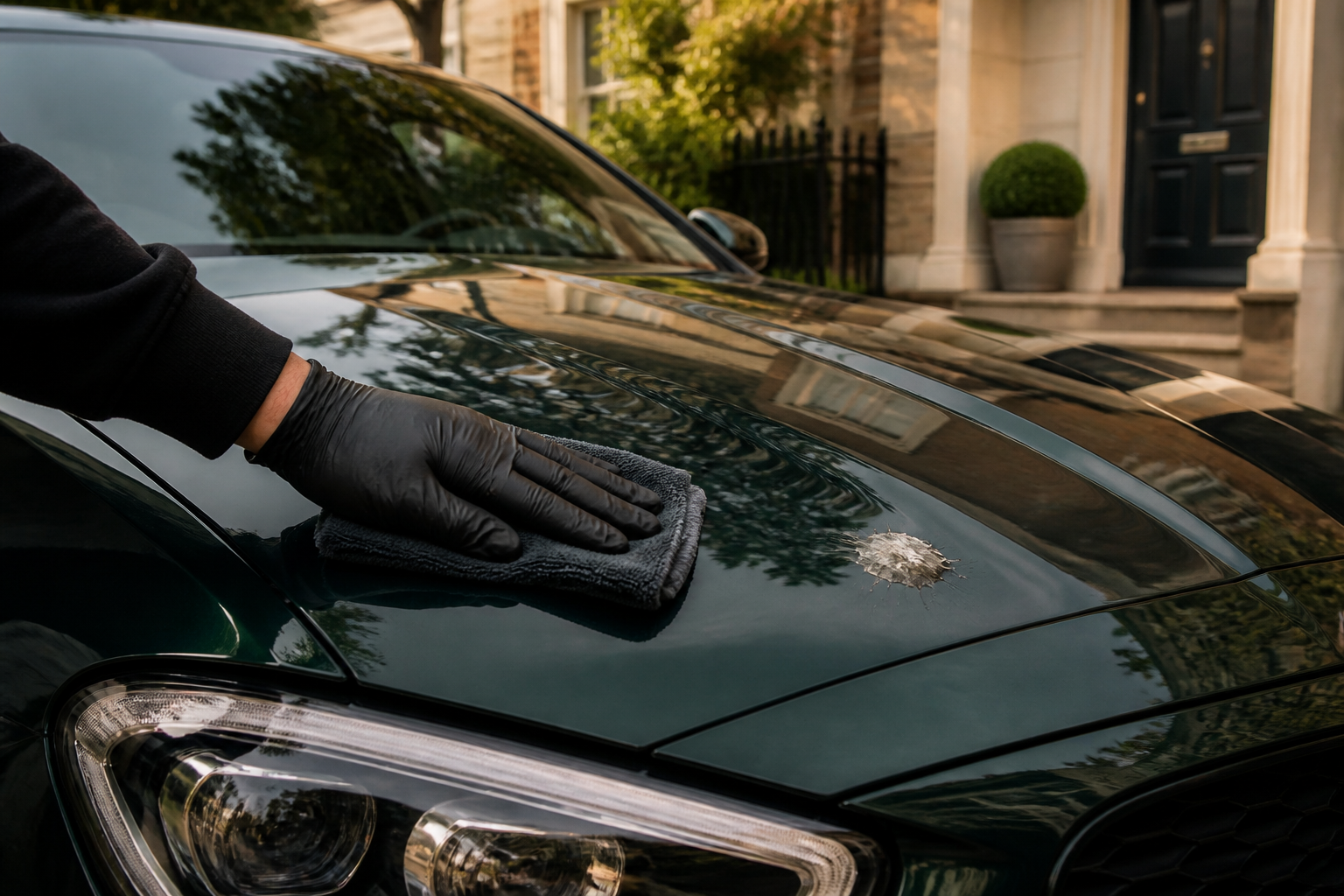
To remove bird droppings from your car paint without scratching, never wipe them dry. Instead, saturate the dropping completely with water or quick detailer spray and let it soak for 3–5 minutes to soften the deposit.
Then gently lift away with a soft microfibre cloth using minimal pressure, folding to a clean section for each wipe.
- and begin etching clear coat within 48 hours in warm conditions or 24 hours in London's summer sun. The granular uric acid crystals in dried droppings act like sandpaper if rubbed, so pre-soaking is essential to prevent paint damage.
Work quickly after discovering droppings, especially on dark-coloured cars where etching shows prominently.
Why bird droppings damage car paint so quickly
- This acidity attacks the clear coat layer that protects your base paint, creating a chemical reaction that softens and then permanently marks the surface.
In London's warmer months (May through September), this etching process accelerates dramatically because heat speeds the chemical reaction.
The damage occurs in stages. Within the first few hours, the acid begins breaking down the clear coat's polymer bonds.
After 12–24 hours in direct sunlight, you'll often see a faint outline even after removing the dropping.
By 48 hours, the etching becomes permanent, requiring machine polishing to remove. Dark colours—black, navy, dark grey—show this damage most visibly as dull spots or rings where the dropping sat.
London drivers face particular challenges. The capital's abundance of pigeons, especially around Westminster, Trafalgar Square, Hyde Park and residential squares in Kensington and Chelsea, means repeated bird dropping incidents.
Many London streets are tree-lined (plane trees, oaks, limes), which attract birds.
If you park under trees in areas like Hampstead, Highgate, or along the Embankment, you're statistically likely to find droppings on your car weekly during nesting season (March to August).
The composition matters too. Bird droppings aren't just acid—they contain seeds, berries, insects and grit.
These create the abrasive component.
When dried, this mixture becomes cement-hard, and any wiping action drags these particles across your paint like 400-grit sandpaper.
The safest method: soak first, wipe second
The golden rule for bird dropping removal is never touch a dried dropping with a cloth until you've softened it completely.
Step 2: Wait 3–5 minutes Allow the moisture to penetrate and soften the deposit. Fresh droppings (under 2 hours old) need 2–3 minutes. Dried droppings (24+ hours) may need 5–8 minutes.
For crusty deposits, apply a damp microfibre cloth over the area like a compress and let it sit.
Step 3: Lift, don't wipe Using a clean, plush microfibre cloth (minimum 300 GSM), gently lift the softened dropping away from the paint. Use a dabbing or lifting motion rather than wiping. The dropping should come away without resistance.
If you feel any drag, stop and re-soak.
Step 4: Fold and repeat Fold your microfibre to a clean section and make a second gentle pass to collect residue. Never reuse a contaminated section of cloth—this drags grit back across the paint.
Step 5: Final wash Wash the area with car shampoo solution (two-bucket method) or professional wash product, then dry with a separate clean microfibre. Inspect under direct light for any remaining staining or etching.
Emergency removal when you're away from home
London drivers often discover bird droppings while parked at work in Canary Wharf, outside a restaurant in Soho, or in a Sainsbury's car park in Clapham.
-
Bottled water works: Buy a bottle of still water from any shop. Pour it slowly over the dropping and let it pool. Wait 5 minutes, then use a clean paper napkin or tissue to lift it away gently. Never use fizzy water (carbonic acid can damage paint) or coffee/tea (tannins stain).
-
Baby wipes as last resort: Unscented, alcohol-free baby wipes contain enough moisture to soften droppings. Press the wipe onto the dropping for 2–3 minutes, then gently lift. This isn't ideal (wipes can contain surfactants that strip wax) but it's vastly better than dry-wiping.
-
Service station wash: Many petrol stations around London (Shell on Cromwell Road, BP on Marylebone Road) have pressure washers. Use the pre-wash foam setting directly on the dropping, let it dwell for 30 seconds, then rinse. Avoid the high-pressure jet directly on the dropping—it can embed particles into the paint.
What to do if the dropping has already etched the paint
If you've successfully removed the dropping but see a dull ring or shadow remaining, you're looking at clear coat etching. This is permanent chemical damage that won't wash away.
Option 1: Machine polishing A dual-action polisher with fine cutting compound (like Meguiar's Ultimate Compound or Scholl Concepts S17+) can remove light to moderate etching in 2–3 passes. This physically levels the clear coat, removing the damaged layer. Professional mobile detailers in London charge £40–80 for spot correction of 3–5 etches.
Full paint correction for a heavily etched car runs £300–600.
Option 2: Hand polishing (limited success) For very light etching visible only in direct sunlight, hand-applied polish with a foam applicator pad can reduce the appearance by 40–60%. Use a fine polish (not compound), work in small circles for 2 minutes per etch, then wipe clean. This won't fully remove etching but improves the look.
Option 3: Professional ceramic coating or paint protection If your car faces repeated bird dropping attacks (common in London's garden squares or near the Thames), consider ceramic coating. These form a sacrificial layer that bird acid attacks instead of your clear coat. Most etchings on ceramic-coated cars wash away completely during regular washing because the coating prevents chemical bonding.
Ceramic coating costs £400–900 for a full car in London, lasts 2–5 years, and dramatically reduces bird dropping damage.
Products that work (and ones that don't)
Effective solutions:
-
Distilled or demineralised water in a spray bottle (avoids London's hard water limescale)
-
pH-neutral quick detailer sprays (Gtechniq W6 Iron & General Fallout Remover, CarPro Ech2O)
-
professional wash concentrates diluted 1:10 in spray bottles
-
Isopropyl alcohol 50:50 with distilled water (dissolves uric acid effectively)
Avoid these:
-
WD-40 or petroleum solvents (they strip wax and can stain paint)
-
Soapy washing-up liquid (too harsh, strips protection, leaves residue)
-
Vinegar or lemon juice (yes, these are acidic too—you're adding more acid to acid damage)
-
Hot water (can bake the acids into the paint faster)
-
Pressure washers aimed directly at dried droppings (embeds particles)
Special considerations for London car owners
Parking under London plane trees London's iconic plane trees line streets in Westminster, Bloomsbury, Belgravia and South Kensington. They attract pigeons, parakeets and crows. If your residents' permit requires you to park under these trees, inspect your car daily during spring and summer.
Keep a quick detailer spray in your car and treat droppings within 24 hours.
Underground car park owners Many luxury developments in Mayfair, Knightsbridge and Nine Elms have underground parking (Cadogan Place, One Hyde Park, Embassy Gardens). Birds don't reach these spaces, but if you park on-street during the day for work, you'll still face bird dropping issues. Consider paint protection film on high-impact areas (bonnet, roof) if your car parks outside frequently.
Hard water complications London water is extremely hard (200–300 ppm calcium carbonate). If you rinse bird droppings with tap water and let it air-dry, you'll add limescale spots on top of the etch. Always use distilled water for rinsing or dry the area immediately with a microfibre cloth.
This is why professional wash solutions work so well in London—no hard water residue.
EV owners with dark paint Tesla Model 3, Polestar 2, and BMW i4 in black or midnight blue show bird dropping etches dramatically. These cars often lack traditional wax protection (many owners skip it). Apply a spray sealant or ceramic coating specifically.
Tesla service centres in Park Royal and Heathrow recommend quarterly paint sealant applications for London-based cars.
Uber and PHV drivers If you're driving for Uber or a private hire operator and park on-street overnight in outer London areas (Ealing, Croydon, Barnet), you'll encounter bird droppings frequently. Budget 5 minutes every morning for a walk-around inspection. Treat droppings immediately—passengers notice paint condition, and it affects ratings.
Keep a spray bottle and microfibres in your boot at all times.
Prevention strategies that actually work
You can't eliminate bird dropping risk entirely in London, but you can reduce it:
Car covers for overnight parking If you have assigned parking in a mews or residents' bay, a fitted car cover (£80–200) prevents 100% of bird droppings. Downside: daily removal and replacement takes 5 minutes. Upside: also protects against tree sap, pollen, and frost.
Avoid peak nesting areas March through August, avoid parking directly under trees where possible. Birds are territorial during nesting and defecate more frequently. If choosing between two residents' bays, take the one away from overhanging branches.
Apply hydrophobic protection Wax, sealants, and ceramic coatings create slick surfaces where droppings don't bond as strongly. Fresh droppings on a well-waxed car often rinse away completely during rain, whereas droppings on unprotected paint etch within hours. Re-wax or re-seal your car every 3 months minimum if parking outdoors in London.
Park in covered spaces when visiting central London Q-Park facilities under Park Lane, Cavendish Square, and Chinatown cost £8–20 for 2–4 hours but eliminate bird dropping risk entirely. If you're visiting the West End, Theatreland or shopping in Covent Garden, covered parking is worth the premium.
The science of damage: clear coat vs base coat
Modern car paint has multiple layers. The base coat provides colour, and a 40–60 micron clear coat layer sits on top for UV protection and gloss.
Bird droppings attack this clear coat first.
Early etching (first 48 hours) only damages the top 5–10 microns, which polishing can remove. Droppings left for a week or more can penetrate 20–30 microns, sometimes reaching the base coat.
At this point, repair requires wet-sanding or respraying, costing £200–500 per panel in London body shops.
Factory clear coat thickness varies by manufacturer. German brands (BMW, Audi, Mercedes) typically apply 50–60 microns.
Japanese brands (Toyota, Nissan) apply 40–50 microns.
Budget brands sometimes use as little as 30 microns. This matters because thinner clear coat etches faster and offers less material for polishing correction.
Frequently asked questions
**Q: I live in a Chelsea mansion block with no outdoor tap—how can I safely remove bird droppings from my car parked on Cadogan Street?
A: Fill a 1-litre spray bottle with distilled water (£1 from Tesco or Boots) and keep it in your flat or car boot. When you discover droppings, spray liberally, wait 5 minutes, then lift away with a plush microfibre cloth.
professional wash products work even better—they contain lubricants that encapsulate dirt and allow safe wiping without .
This method is legal on Westminster streets (unlike hose washing, which violates most residents' parking terms) and prevents the limescale spots you'd get from London's hard tap water anyway.
**Q: How quickly does bird poo etch car paint during London summers vs winters?
A: In London summer (June–August) when temperatures reach 25–30°C and cars sit in direct sun, bird droppings can cause visible etching within 12–18 hours. The combination of heat and UV radiation accelerates the acid reaction significantly.
In winter (December–February) with temperatures of 5–10°C and cars mostly in shade, the same etching process takes 3–5 days.
However, winter droppings often contain more grit from birds' winter diets, increasing scratch risk during removal. Inspect daily during summer, every 2–3 days in winter, especially if you park on-street in pigeon-heavy areas like Piccadilly, Borough Market, or Hampstead Heath vicinity.
**Q: My Polestar 2 in midnight blue has permanent etch marks from bird droppings after parking under Battersea Park trees—can these be fixed without repainting?
A: Yes, if the etching hasn't penetrated through the entire clear coat layer. A professional machine polisher using a dual-action tool and fine cutting compound can remove 90–100% of etches that are less than 3 months old.
Several mobile detailers serve Battersea and Clapham areas and will come to your address or the underground car park at Battersea Power Station development.
Expect to pay £60–100 for spot correction of 5–8 etch marks. If etching has reached the base coat (you can feel a depression with your fingernail), wet-sanding or respraying is required.
For future protection, ceramic coating your Polestar costs £500–700 and dramatically reduces bird dropping damage—the coating takes the acid attack instead of your paint.
**Q: I'm an Uber driver parking overnight in Ealing—birds constantly target my black Toyota Prius. Is there a quick method I can use every morning before starting shifts?
Takes 90 seconds per dropping. professional wash products cost £12–18 per litre concentrate (makes 10–20 bottles when diluted), so your cost per treatment is under 10p.
The key is consistency—treat droppings daily, never let them sit 48+ hours.
Black Priuses show etching worst of all common PHV cars. If you're parking under the same tree repeatedly, consider a half-cover (bonnet and roof only, £40–60) that you can remove in 60 seconds before driving.
**Q: Will London's hard water make bird dropping damage worse, and should I avoid using tap water from my Notting Hill garden hose?
A: London water averages 250–300 ppm calcium carbonate (very hard), and yes, this complicates bird dropping removal. If you rinse droppings with tap water and let it air-dry, you'll deposit limescale spots that create their own dull marks—essentially trading bird etch marks for water spots.
If using a garden hose in Notting Hill (where many houses have small front gardens), rinse the area after removing the dropping, then immediately dry with a clean microfibre towel.
Better option: use distilled water or a professional wash product that doesn't require rinsing. Many Notting Hill residents with nice cars (Porsche, Range Rover, Tesla) invest in de-ionising filters for their garden hoses (£80–150) which remove the calcium and magnesium, preventing water spots entirely.