How to Remove Cigarette and Weed Smell from Car Interior
This guide covers remove cigarette smell from car for London drivers: what it involves, what it costs and how Valetly handles it.
To eliminate cigarette and cannabis smoke smell from your car interior, you need a three-stage approach: deep vacuum all surfaces including vents and crevices, apply an enzymatic odour eliminator or ozone treatment to break down smoke particles trapped in upholstery and carpets, then replace the cabin air filter which absorbs and redistributes odours.
The process takes 4–8 hours depending on severity.
Surface sprays and air fresheners only mask the smell temporarily — smoke particles embed into porous materials and require chemical neutralisation. In London's damp climate, trapped moisture actually intensifies lingering smoke odours, making thorough drying essential after any wet cleaning.
Why Smoke Smell Is So Difficult to Remove
Cigarette and cannabis smoke doesn't just sit on surfaces — it penetrates them. Smoke contains thousands of volatile organic compounds (VOCs) and tar particles that bond with fabric fibres, foam padding, plastic dashboard materials, and the HVAC system.
Every time you smoke in a car with windows closed, these particles settle on every surface and work their way deep into upholstery.
The smell is particularly stubborn because:
-
Tar and resin are sticky: They create an oily film that traps odour molecules in place
-
Porous materials absorb smoke: Cloth seats, headliners, carpets and door cards act like sponges
-
HVAC systems recirculate odours: The cabin filter, evaporator core and air ducts hold smoke residue
-
Heat reactivates smell: On warm days, trapped particles release odours again
In London, high humidity (average 70–80% year-round) makes the problem worse. Moisture reactivates dormant smoke particles, which is why the smell often returns stronger after rain or when you run the heater.
This is especially noticeable in underground car parks in developments like Battersea Power Station or One Hyde Park, where ventilation is limited and humidity concentrates odours.
Step 1: Deep Vacuum Everything
Before applying any cleaning products, remove as much loose smoke residue as possible. This prevents you from just spreading tar particles around when you start wet cleaning.
What you need:
-
Wet/dry vacuum with upholstery attachment
-
Detailing brushes (soft bristle for vents, stiff for carpets)
-
Compressed air canister
-
Microfibre cloths
Process:
-
Remove all items from the car — floor mats, seat covers, air fresheners, anything in door pockets
-
Use compressed air to blow out dashboard vents, then immediately vacuum up the dislodged dust and tar particles
-
Vacuum all fabric surfaces using overlapping strokes: seats (remove cushions if possible), carpets, headliner, door cards, parcel shelf, boot lining
-
Use detailing brushes to agitate carpet fibres before vacuuming — this lifts embedded particles
-
Vacuum under and between seats, using crevice tools for tight gaps
-
Remove and vacuum floor mats separately, then leave them outside to air
For Uber and private hire drivers in London, this step alone removes about 30% of the smell. If you're preparing a vehicle for PHV licensing inspection in zones like Westminster or Camden, visible tar staining will fail cleanliness standards.
Step 2: Clean All Hard Surfaces
Smoke leaves a greasy film on glass, plastics and leather. This film is what causes that brown-yellow tint on the inside of windscreens.
What you need:
-
Isopropyl alcohol (70% solution) or dedicated interior cleaner
-
All-purpose cleaner (pH-neutral)
-
Glass cleaner (ammonia-free for tinted windows)
-
Multiple microfibre cloths
-
Soft detailing brushes
Process:
-
Windows and mirrors: Spray glass cleaner, wipe in straight lines (not circles) using a clean microfibre cloth. Flip to a dry side and buff. Repeat until the cloth comes away clean — heavily smoked cars need 3–4 passes per window
-
Dashboard, centre console, door panels: Spray all-purpose cleaner onto a cloth (never directly onto surfaces near electronics). Wipe down all plastic and vinyl. Pay attention to textured surfaces where tar collects
-
Steering wheel, gear selector, handbrake: These absorb oils from hands as well as smoke. Use isopropyl alcohol on a cloth for deep cleaning
-
Leather seats: Use a leather-specific cleaner. Smoke residue damages leather's protective coating over time. Follow with a leather conditioner to prevent cracking
In London's stop-start traffic (especially around congestion charge zones), drivers often smoke with windows barely cracked. This concentrates residue on the driver's side.
Give extra attention to the driver's door panel, A-pillar and side window.
Step 3: Deep Clean Upholstery and Carpets
This is where you tackle the main odour source. Standard vacuuming only removes surface particles — you need to break down the tar and VOCs embedded in fabric fibres.
What you need:
-
Fabric upholstery cleaner or enzymatic odour eliminator
-
Hot water extraction machine (hire from tool rental shops) OR steam cleaner
-
Stiff scrubbing brush
-
Wet/dry vacuum
-
Baking soda (optional pre-treatment)
Process:
-
Optional pre-treatment: Sprinkle baking soda liberally over all fabric surfaces. Leave for 2–3 hours (or overnight). Baking soda is alkaline and neutralises acidic smoke compounds. Vacuum thoroughly before wet cleaning
-
Apply upholstery cleaner: Spray enzymatic cleaner onto seats, carpets and headliner. Work in sections. Let it dwell for 5–10 minutes (check product instructions)
-
Agitate with brush: Use circular motions to work the cleaner into fibres. You're trying to lift tar from deep in the foam padding
-
Extract: If using a hot water extraction machine, make slow overlapping passes. Extract as much moisture as possible. If using a spray cleaner without extraction, blot firmly with clean microfibre cloths — you need to physically remove the dissolved tar, not just spread it around
-
Repeat on heavy staining: Badly smoke-stained seats (common in ex-smoker trade-ins) may need 2–3 cleaning cycles
For London drivers in flats without outdoor drying space, wet upholstery creates a problem. Park in a well-ventilated area (not a sealed underground car park) and leave all doors and windows open.
Use a dehumidifier or fan to speed drying.
Damp interiors in enclosed spaces develop mildew, adding another odour problem.
Step 4: Replace the Cabin Air Filter
This is non-negotiable. The cabin air filter sits in your HVAC system and traps airborne particles — including smoke.
Even after cleaning everything else, a saturated filter will reintroduce the smell every time you turn on the fan.
Location: Usually behind the glovebox or under the dashboard. Check your vehicle's manual.
Cost: £10–£30 for the part. Takes 10 minutes to replace.
Process:
-
Locate the cabin filter access panel
-
Remove the old filter — it will likely be discoloured and smell strongly
-
While the filter is out, use a vacuum crevice tool to clean the filter housing
-
Install the new filter, ensuring the airflow direction arrow points correctly
For EV owners in London (Tesla Model 3, Polestar 2, BMW i4), cabin filter replacement is identical to petrol cars despite the different HVAC systems. Tesla owners can enable "Bioweapon Defense Mode" after installing a new HEPA filter, which runs the fan at maximum to purge the ductwork.
Step 5: Treat the HVAC System
Even with a new filter, smoke residue clings to the evaporator core and air ducts. This is why the smell often returns when you first turn on the air conditioning.
What you need:
-
HVAC odour eliminator spray (aerosol designed for automotive use)
-
OR ozone generator (hire only — see warnings below)
Process for aerosol treatment:
-
Start the engine, set climate control to recirculation mode, fan on maximum, temperature on cold
-
Spray the odour eliminator into the fresh air intake (usually at the base of the windscreen under the bonnet, passenger side)
-
Let the system run for 10 minutes, pulling the treatment through the entire HVAC system
-
Switch to fresh air mode, continue running for 5 minutes to purge
-
Turn everything off, let the car sit for 30 minutes
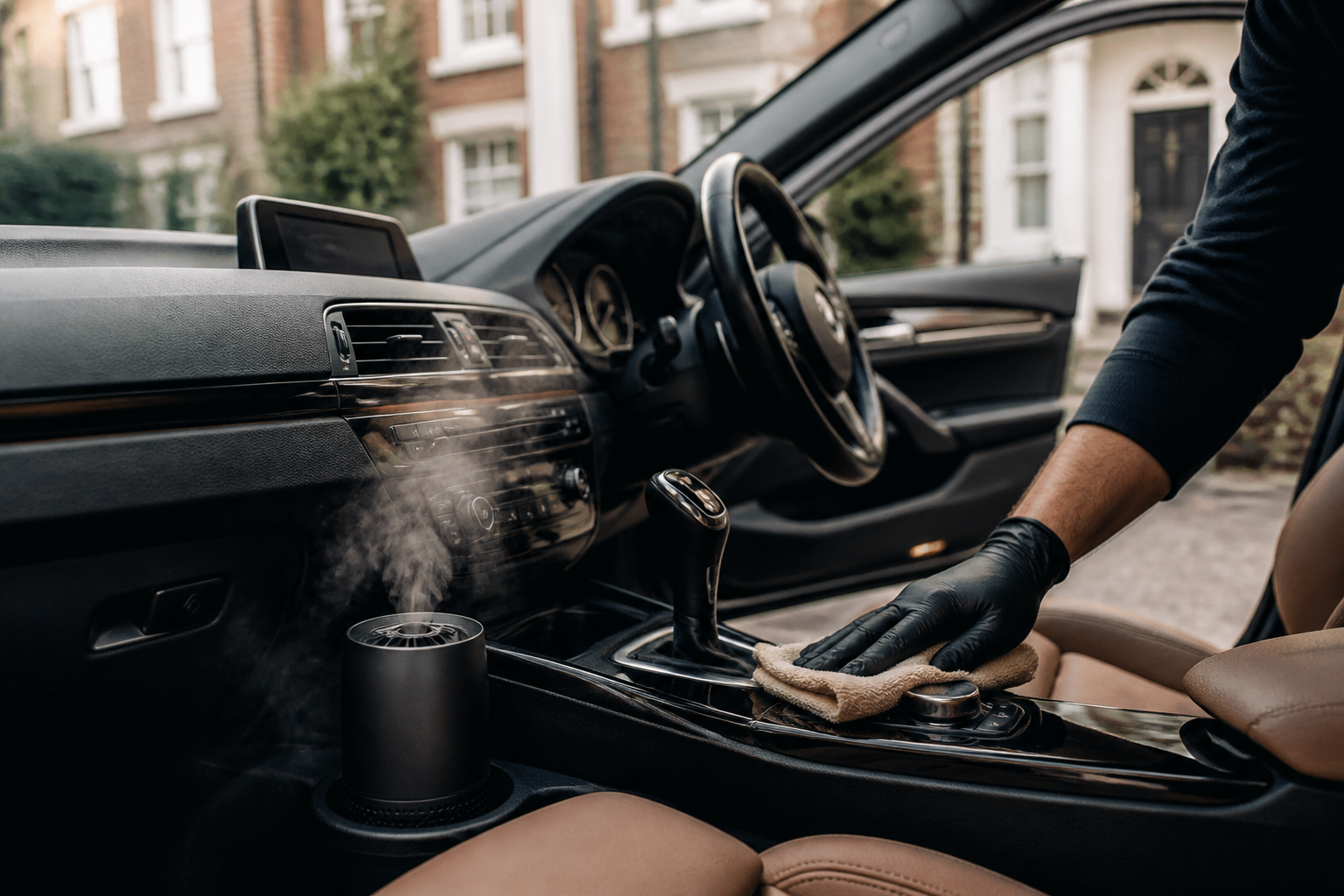
Ozone treatment (professional method):
Ozone generators produce O₃, which chemically breaks down odour molecules. This is highly effective for smoke but comes with strict safety requirements.
-
Never remain in the vehicle while ozone is running (O₃ is toxic to humans and pets)
-
Run the generator for 30 minutes to 2 hours depending on smell severity
-
Air out the vehicle for at least 1 hour before re-entering
-
Ozone degrades rubber and plastics over time — don't overuse
In London, several mobile detailers offer ozone treatment as an add-on service. If you're in a mews property in Kensington or a gated estate in Dulwich with no garage space, a mobile service brings the equipment to you.
Expect to pay £80–£150 for professional ozone treatment.
Step 6: Odour Absorbers and Prevention
Once you've removed the source of the smell, use passive absorbers to capture any remaining VOCs.
Effective options:
-
Activated charcoal bags: Place under seats and in door pockets. Replace every 2–3 months. Not scented, just absorbs odours
-
Baking soda in open containers: Leave overnight, vacuum up in the morning. Cheap and effective
-
White vinegar in bowls: Leave overnight with windows closed (smell dissipates as vinegar dries). Neutralises alkaline smoke residue
What doesn't work long-term:
-
Hanging air fresheners: Mask smell but don't remove it
-
Febreze and fabric sprays: Temporary only, smell returns within days
-
Scented bombs: Add fragrance on top of smoke smell, creating a worse combination
Prevention: If you must smoke in your car:
-
Keep at least two windows fully open (cross-ventilation)
-
Use an ashtray, don't ash out the window (ash blows back in)
-
Run the fan on fresh air mode, never recirculation
-
Smoke near the end of your journey so you can air out immediately
For London Uber and PHV drivers, smoking in a licensed vehicle is illegal and grounds for licence suspension. Even residual smell from personal smoking can trigger passenger complaints to TfL.
Professional vs DIY: What to Expect
DIY smoke removal takes 6–8 hours of active work, plus drying time. Cost is £50–£100 in materials if you already own a wet/dry vacuum, or £150–£200 if you need to hire a hot water extractor.
Professional detailers in London charge £200–£400 for full smoke odour removal, including:
-
Steam cleaning or extraction of all fabric surfaces
-
Ozone treatment
-
HVAC system treatment
-
Leather conditioning
-
New cabin filter
The professional advantage is commercial-grade equipment (truck-mounted extractors pull more moisture out than rental machines) and experience knowing which surfaces hold smell worst.
For severe cases — cars smoked in daily for years — even professional treatment may not achieve 100% elimination. The smell can permeate sound-deadening foam behind door cards and under carpets, which requires partial interior disassembly to access.
Timeline and Realistic Expectations
Light smoking (occasional passenger, windows open): 1 cleaning cycle usually sufficient. Smell eliminated in 90% of cases.
Moderate smoking (regular driver who smoked with windows cracked): 2 cleaning cycles over 2 days. Ozone treatment recommended.
Smell reduced by 85–95%.
Heavy smoking (daily smoker, windows closed, years of use): Multiple cleaning cycles, ozone treatment, possibly replacing severely stained components (headliner, seats). Smell reduced by 70–85%.
Complete elimination may require replacing porous materials.
In London's climate, always factor in drying time. Wet interiors in October–March can take 24–48 hours to fully dry in an underground car park.
If you're in a flat in areas like Shoreditch or Brixton without private parking, consider booking a car park with better ventilation or using a garage with forced air drying.
Cannabis vs Tobacco: Key Differences
While the removal process is identical, there are practical differences:
Cannabis smoke:
-
Stronger immediate smell but often dissipates faster than tobacco
-
Resin content varies by quality (higher-grade concentrates leave more residue)
-
Less tar staining on hard surfaces
-
Still illegal to drive under influence (police can smell residual odour even after cleaning)
Tobacco smoke:
-
Higher tar content creates more visible staining
-
Nicotine residue leaves yellow-brown film on glass and plastics
-
Smell lingers longer due to chemical additives in cigarettes
-
Third-hand smoke (residue on surfaces) remains toxic to children and pets
For resale purposes in London, vehicles with any smoke smell are typically valued £500–£1,500 lower than equivalent non-smoker cars. Dealers often refuse part-exchange on heavily smoked vehicles, as trade buyers deduct reconditioning costs.
Frequently Asked Questions
**Q: I live in a Chelsea mansion block with no outdoor parking. How can I air out my car after wet cleaning without leaving it on the street?
A: Book a session at a covered car park with good ventilation (like the NCP at Cadogan Place) and leave all doors open for 3–4 hours. Alternatively, use a 12V portable fan or dehumidifier powered from your cigarette lighter socket — this speeds drying in enclosed spaces.
Some London detailers offer forced-air drying as part of their mobile service, bringing equipment that pulls moisture out in 60–90 minutes.
If you have residents' parking, wet-clean on a dry, breezy day and park in the most exposed spot on your street to maximise airflow.
**Q: Will the cigarette smell in my car fail a TfL private hire vehicle inspection in London?
A: Yes, potentially. TfL compliance officers assess interior cleanliness during licensing inspections, and strong odours (smoke, food, pet smells) can result in a fail or advisory note requiring remediation before licence approval.
PCO-licensed vehicles must meet "acceptable standards of comfort and cleanliness" — smoke smell violates this.
Even if you pass inspection, passengers can report odours via the TfL app, triggering a compliance review. Remove all smoke smell before booking your inspection at centres in Sidcup or Hounslow.
**Q: Does London's hard water make cleaning smoke smell harder?
A: Yes. London water averages 280–320 ppm hardness (very hard), which leaves limescale deposits when you wet-clean upholstery.
These deposits can trap residual smoke particles and create a musty smell on top of the original odour.
Use distilled or deionised water in your hot water extractor or steam cleaner, especially for final rinse passes. If you've already cleaned with tap water and notice a chalky residue, re-clean with a 50/50 mix of distilled water and white vinegar to dissolve limescale, then extract thoroughly.
**Q: I bought a used Polestar 2 in Canary Wharf that smells of weed — does the electric system make odour removal different?
A: The cleaning process is identical (EVs have the same upholstery, carpets and HVAC systems as petrol cars), but you have one advantage: no hot engine bay that bakes smells into sound insulation. The battery pack under the floor is sealed, so smoke doesn't penetrate there.
Follow the same steps — deep vacuum, upholstery extraction, new cabin filter, ozone treatment if needed.
EV-specific tip: set the climate pre-conditioning (via app) to run the ventilation at maximum while you air out the car after cleaning. This purges the HVAC ducts without running the main battery down, useful if you're parked in a Canary Wharf office car park during working hours.
**Q: My Notting Hill flat has no parking — can mobile detailers treat smoke smell on the street, or do I need a garage?
A: Mobile detailers in London routinely work on-street in areas like Notting Hill, Hampstead and Battersea, provided you have a valid residents' permit. Smoke odour removal requires 3–4 hours of on-site work (wet cleaning, drying time, ozone if used).
The detailer brings a generator or battery power for extraction machines.
Two challenges: (1) drying takes longer on humid days (typical April–June in London with spring rain). The detailer may need to return the next day to complete the job.
(2) ozone treatment requires the car to sit sealed for 1–2 hours, then air out for another hour, which works fine on a street bay but irritates residents if your car alarm triggers (ozone can affect sensitive sensors). Book on a weekday morning for fastest drying and least disruption.