How to polish a car correctly, and is it different from waxing?
Learning how to polish a car involves using a fine abrasive to smooth the paint's surface, removing dullness and minor imperfections to restore gloss. This is a corrective step, not a protective one.
After polishing, you must apply a wax or sealant to protect the newly exposed, pristine paint from the elements, locking in the shine.
Key facts
What's the real difference between car polish, wax, and sealant?
Understanding the distinction between these products is crucial for achieving a lasting finish. Car polish is a mildly abrasive compound designed to remove a very thin layer of the paint's clear coat.
This action levels the surface, removing light swirl marks, oxidation, and the dullness caused by traffic film and contaminants. Polishing creates shine but offers zero protection.
A car wax or sealant, on the other hand, is non-abrasive. Its job is to form a protective, hydrophobic (water-repelling) layer over the paint.
This layer shields the finish from UV rays, road salt, bird droppings, and tree sap.
Waxes are often based on natural ingredients like carnauba, giving a warm glow, while sealants are synthetic polymers that offer longer-lasting durability.
Think of it as a two-stage process: polishing is the preparation, and waxing or sealing is the preservation. Applying wax directly onto dull, unpolished paint will only seal in the imperfections, making them look slightly wetter but not removing them.
True gloss comes from a perfectly smooth surface, which only a polish can achieve.
| Product Type | Primary Function | Durability | Finish | Application |
|---|---|---|---|---|
| Car Polish | Corrects paint | None | High gloss | Before waxing |
| Carnauba Wax | Protects paint | 1–3 months | Warm, deep glow | After polishing |
| Synthetic Sealant | Protects paint | 4–12 months | Sharp, reflective shine | After polishing |
| Hybrid Ceramic Wax | Protects paint | 6-12+ months | Very sharp, durable | After polishing |
Is hand polishing worth the effort, or is machine polishing essential?
Hand polishing can be effective for small, targeted areas or for applying a very gentle, non-abrasive glaze. However, for an entire vehicle with noticeable dullness or swirl marks, it is an extremely labour-intensive process with limited results.
You will expend significant energy for only a modest improvement in shine, as it's difficult to apply enough consistent pressure to correct paint imperfections by hand.
Machine polishing is the industry standard for a reason. A dual-action (DA) polisher oscillates in a random orbit, generating friction and heat safely to work the polish effectively.
This method is thousands of times faster and more efficient than hand application, capable of removing moderate defects and producing a true, mirror-like finish. For anyone serious about restoring their car's paint, a machine is not a luxury; it is essential.
Warning: Applying too much pressure with a machine polisher, especially a rotary type, can burn through the clear coat in seconds. Beginners should always start with a dual-action machine and the least aggressive pad and polish combination.
For most London drivers, especially those without a dedicated driveway or the time for a multi-hour project, booking a professional with the correct equipment is more practical. It removes the risk of damaging your paint and guarantees a high-quality result.
Polishing a car is a skill that requires practice.
How do London's parking and water rules affect how to polish a car?
Polishing a car in London presents unique challenges that most online guides ignore. The entire process hinges on having a perfectly clean car, which is difficult without access to a private driveway and outside tap.
London's notoriously hard water leaves mineral deposits if left to dry on the paint, creating more work.
Many residential streets are permit-only, with restrictions on carrying out vehicle maintenance. In areas like Hampstead, performing a multi-hour detail on the street may not be feasible.
Underground car parks in blocks of flats often have poor lighting, low ceilings, and a lack of power sockets, making machine polishing impossible. For these reasons, a DIY approach to learning how to polish a car is often impractical in the capital.
Tip: If polishing outdoors, always work in the shade. Direct sunlight can bake polish onto the paint, making it extremely difficult to remove.
A mobile valeting service circumvents these issues. Professional valets arrive in fully equipped vans with their own filtered water and power sources.
They are accustomed to working within the constraints of London's varied parking situations, from tight shared driveways to designated bays, ensuring the job is done correctly and without issue. This is often the only viable option for achieving a professional finish at home.
What is the correct step-by-step process for polishing a car?
Achieving a flawless finish requires a methodical approach. Skipping a step, especially the initial cleaning, will mean you are grinding existing dirt into the paint, causing more damage than you fix.
A professional detailer will always follow a strict order of operations for safety and quality.
Key figure: A car's clear coat is typically only 40-50 microns thick, the width of a human hair. Each polish removes a small amount, so it should not be done excessively.
The essential sequence is as follows:
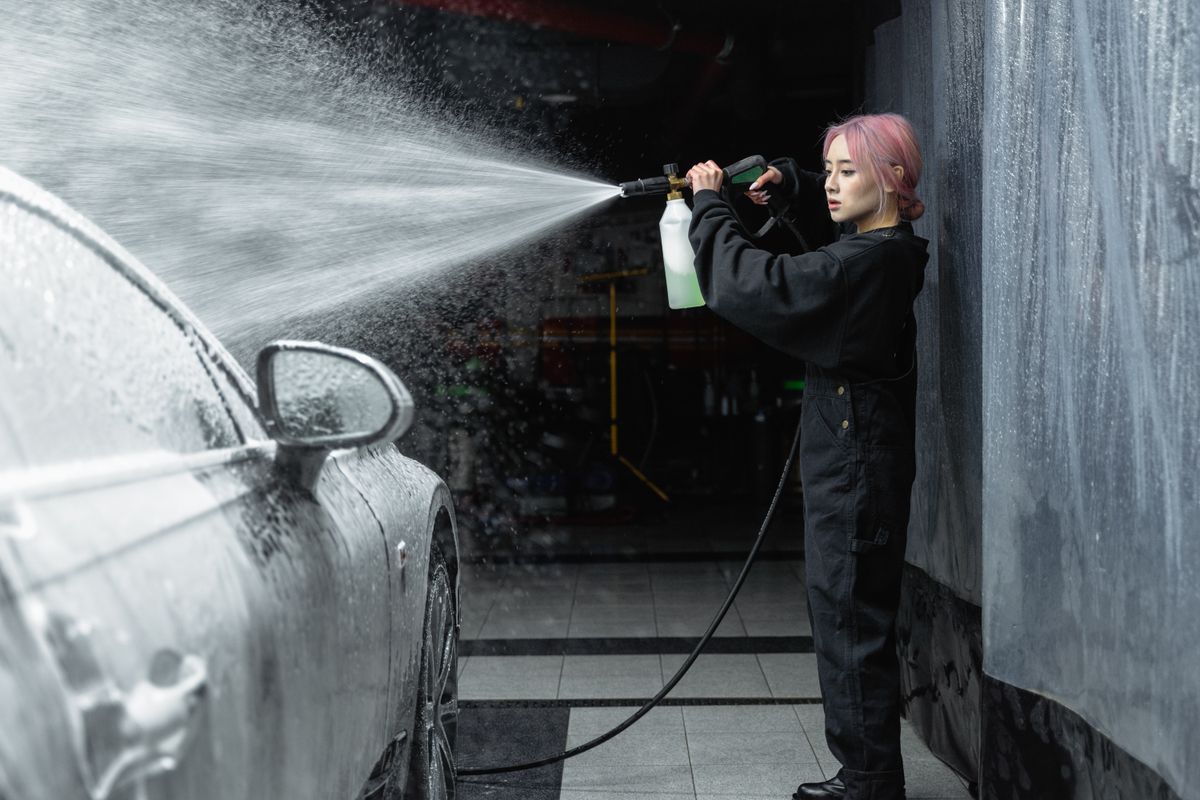
- Thorough Wash: The car must be completely free of loose dirt and grit. This involves a pre-wash and a careful contact wash of all exterior surfaces.
- Decontamination: After washing, the paint will still have bonded contaminants like tar, iron fallout (from brake dust), and tree sap. These are removed with a clay bar and lubricant, which gently lift them from the surface. The paint should feel perfectly smooth to the touch before proceeding.
- Polishing: Mask off any sensitive plastic or rubber trim with painter's tape. Apply a small amount of car polish to a foam pad (either on a machine or a hand applicator). Work in small, 50cm x 50cm sections with overlapping passes until the polish becomes clear.
- Wipe Down: Use a clean, soft cloth to remove the polish residue and inspect the finish. An isopropyl alcohol (IPA) solution is often used to ensure all oils from the polish are gone, revealing the true state of the paint.
- Protection: This final, crucial step involves applying a layer of wax or sealant to protect the newly corrected paint and provide a durable, hydrophobic finish. Without this, the fresh paint is exposed and will degrade quickly.
When should I avoid polishing my car?
Polishing is a corrective procedure, and there are times when it's either unnecessary or actively harmful. Knowing when not to polish is as important as knowing how.
The most obvious case is with a brand-new car. The factory paint is in its best possible condition and has maximum thickness.
It needs protection (wax or sealant), not correction.
Avoid polishing in extreme conditions. Attempting to polish in direct, hot sunlight will cause the product to dry instantly on the panel, making it grabby and difficult to buff off.
Similarly, working in near-freezing temperatures prevents the polish from breaking down correctly, leading to poor results.
The ideal temperature range is between 15°C and 25°C in a shaded, controlled environment.
If your car's paint is peeling, cracking, or showing signs of clear coat failure, polishing will only make it worse. The process abrades the surface, and if the top layer is already compromised, it can accelerate the damage significantly.
This is a job for a bodyshop, not a detailer.
Finally, if the paint is just dirty, a thorough wash and decontamination might be all that's needed to restore its shine. Don't assume dull paint always requires an abrasive polish.
Frequently asked questions
Conclusion
Polishing a car is the single most effective way to restore its visual appeal, removing the dullness that washing alone cannot fix. It is a corrective process that prepares the surface for a protective layer of wax or sealant.
While a dedicated owner can achieve good results, the process is demanding and requires specific conditions often unavailable in a city like London.
For a guaranteed, professional result without the hassle, book a vetted and insured mobile valet through Valetly.
Valetly is a London mobile valeting marketplace (company number 17255496) connecting vetted, insured independent valets with drivers across all 32 London boroughs, with fixed prices from £75.